
Air Freight in Germany
By Arash Wahedi, Berlin – September 18, 2024 – Reading time: 7 minutes
Development and Growth of German Air Freight
Air freight is a crucial component of the German economy and plays a central role in international trade. Airports such as Frankfurt, Munich, and Leipzig/Halle are among the most important air freight hubs in Europe and worldwide. This article highlights recent developments and analyzes Germany’s position in international comparisons, as well as the potential of German air freight in the global market.
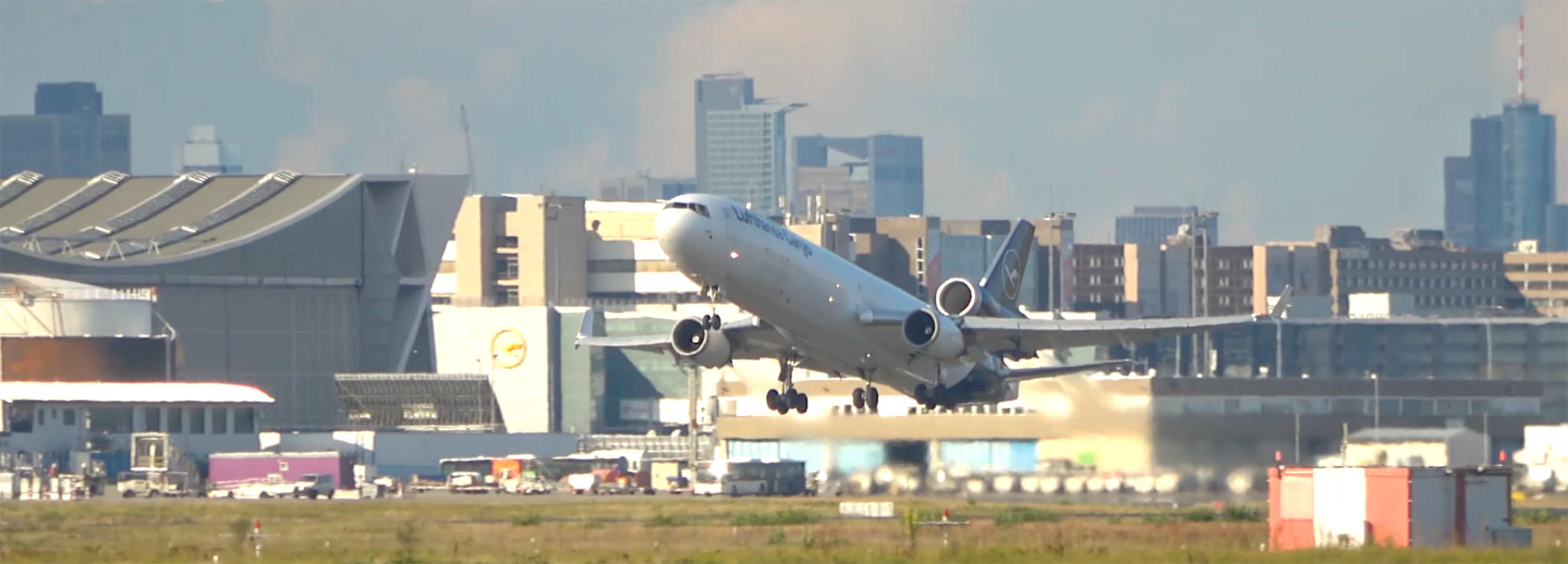
In the picture: Lufthansa Cargo aircraft taking off at Frankfurt Airport
Lufthansa Cargo is one of the leading companies in global air freight, serving over 300 destinations worldwide. The fleet consists of 18 Boeing 777F long-haul freighters and 4 Airbus A321F medium-haul freighters. Additionally, Lufthansa Cargo utilizes the belly cargo capacities of passenger aircraft from Lufthansa and its partners, such as Austrian Airlines and Brussels Airlines, providing maximum flexibility and reach.
Approximately 40% of the total cargo volume at Frankfurt Airport is handled by Lufthansa Cargo. The company is particularly active in sectors like pharmaceuticals, the automotive industry, and e-commerce, with a significant portion of the transported goods being temperature-controlled, crucial for medical and technological industries. Furthermore, Lufthansa Cargo is part of the joint venture “Cargo iQ,” which promotes greater transparency and efficiency in the global air freight sector.
Air Freight in International Comparison: Germany, China, and Qatar
Air freight is a key factor in global trade, and Germany is one of the leading nations in Europe. However, in an international comparison, countries like China and Qatar demonstrate their own strength and unique dynamics. This article examines how these countries are evolving and the approaches they are taking to increase air freight capacity.
Germany recorded approximately 4.8 million tons of air freight in 2023, with most of it handled through Frankfurt and Leipzig airports. Its central location in Europe, combined with well-developed infrastructure, makes Germany a significant hub for European air freight. However, challenges arise from competition in the global market, especially due to rapidly growing freight volumes in other regions of the world.
China, on the other hand, dominates the international air freight market with 19.5 million tons in 2023. The reasons for this massive volume are the sheer size of the country, with 1.4 billion people, and the rapidly growing e-commerce sector. China’s strategy for strengthening its air freight infrastructure is heavily based on technological innovations, particularly in automation and digitization. Airports like Beijing, Shanghai, and Guangzhou play a central role in China’s global freight strategy and are critical for both export and increasingly for import. The 30% increase in freight volume towards Europe highlights the strategic importance of China’s air freight industry.
Qatar, although small in both geographical size and population, has established itself as a key player in the international air freight market thanks to its strategic location and targeted investments. With a population of only 3 million people and a freight volume of 2.6 million tons, Qatar demonstrates the importance of strategic location and specialization. Notably, its focus on temperature-controlled freight, such as pharmaceuticals, is of great importance. Qatar Airways Cargo is one of the world’s leading cargo airlines and efficiently serves routes between Europe, Asia, and North America due to the country’s excellent geographical position. Qatar has managed to secure a significant position in the global freight business despite its small size through a niche strategy.
Potential for improvement exists for Germany, despite its already strong foundation in the air freight market, particularly through increased digitization and automation of logistics processes. The use of modern technologies to optimize freight flows and better network logistics systems could further increase efficiency. Additionally, specializing in air transport for goods such as pharmaceuticals and high-tech products presents an opportunity to further develop these strengths.
The following table compares Europe’s largest airports by their air freight performance based on freight volume, capacity, and value of goods. Among the top 15 ranked airports, four German airports are included: Leading the list is Frankfurt Airport, followed by Leipzig/Halle, Cologne/Bonn, and Munich, all of which play a central role in international air freight traffic.
| # | Airport (City) | Combined Ranking Score | Growth in % (2018-2023) | Tonnage (2021-2023) | Approx. Volume in m³ | Approx. Market Value in € | Main Exported Products |
|---|---|---|---|---|---|---|---|
| 1 | Frankfurt (Germany) | 1.00 | 3.2 | 2,228,796 | 3,450,000 | 85 billion | Automotive parts, electronics, pharmaceuticals |
| 2 | Paris Charles de Gaulle (France) | 0.92 | 4.1 | 2,000,000 | 3,100,000 | 80 billion | Pharmaceuticals, perishables, fashion goods |
| 3 | Amsterdam Schiphol (Netherlands) | 0.85 | 2.5 | 1,667,304 | 2,800,000 | 75 billion | Flowers, electronics, machinery |
| 4 | Leipzig/Halle (Germany) | 0.80 | 7.8 | 1,600,000 | 2,700,000 | 70 billion | E-commerce goods, industrial machinery |
| 5 | Liège (Belgium) | 0.78 | 6.5 | 1,400,000 | 2,400,000 | 65 billion | Pharmaceuticals, perishables, e-commerce |
| 6 | London Heathrow (UK) | 0.75 | 1.9 | 1,397,103 | 2,300,000 | 60 billion | Luxury goods, electronics, pharmaceuticals |
| 7 | Madrid Barajas (Spain) | 0.71 | 5.0 | 1,000,000 | 1,700,000 | 55 billion | Electronics, pharmaceuticals, textiles |
| 8 | Luxembourg (Luxembourg) | 0.67 | 6.7 | 950,000 | 1,600,000 | 52 billion | Pharmaceuticals, electronics, machinery |
| 9 | Milan Malpensa (Italy) | 0.62 | 4.3 | 720,000 | 1,200,000 | 40 billion | Fashion goods, industrial products, pharmaceuticals |
| 10 | Brussels (Belgium) | 0.60 | 5.5 | 650,000 | 1,100,000 | 38 billion | Pharmaceuticals, perishables, machinery |
| 11 | Zaragoza (Spain) | 0.58 | 9.0 | 630,000 | 1,050,000 | 35 billion | Automotive parts, textiles, electronics |
| 12 | Vienna (Austria) | 0.55 | 3.3 | 600,000 | 1,000,000 | 32 billion | Pharmaceuticals, electronics, industrial goods |
| 13 | Cologne Bonn (Germany) | 0.52 | 5.1 | 570,000 | 950,000 | 30 billion | E-commerce, electronics, automotive |
| 14 | Munich (Germany) | 0.50 | 3.7 | 550,000 | 900,000 | 28 billion | Automotive parts, electronics, pharmaceuticals |
| 15 | Oslo Gardermoen (Norway) | 0.47 | 4.6 | 500,000 | 850,000 | 25 billion | Seafood, pharmaceuticals, machinery |
Air Freight in Germany – Top 5 Airports
Frankfurt Airport (FRA)
Frankfurt Airport remains the largest air freight hub in Germany and one of the world’s leading cargo airports. Approximately 2.3 million tons of cargo are handled annually, with Lufthansa Cargo playing a key role. The company is investing 600 million euros in a modernization project, expected to be completed by 2030, to transform the Lufthansa Cargo Center (LCC) into Europe’s most modern freight center. This expansion includes the digitization of logistics processes and the construction of a state-of-the-art high-bay warehouse. Forecasts predict an increase in freight volume to over 3 million tons by 2040, representing a 50% increase compared to previous highs.
Munich Airport (MUC)
Munich Airport is primarily known for the transport of high-value goods like electronics and pharmaceuticals. In 2023, the freight volume was 284,000 tons, making Munich the only major German airport to record growth. This is mainly due to freight carried in the belly of passenger planes, particularly on long-haul routes to Asia and the USA. The airport plans to expand its multimodal solutions to further boost air freight in the coming years.
Leipzig/Halle Airport (LEJ)
With an annual cargo volume of 1.38 million tons, Leipzig/Halle has established itself as Germany’s second-largest cargo airport. The airport is particularly strong in the express and e-commerce sectors, serving as a major hub for DHL and other large logistics providers. The dynamic growth of online commerce is expected to drive increasing demand for fast and efficient freight handling. To meet the growing demand, the airport plans to invest in its logistics capacities.
Berlin Brandenburg Airport (BER)
Since its opening in 2020, Berlin Brandenburg Airport has gradually expanded its role as a cargo center. However, its annual cargo volume remains relatively low compared to other German airports. With a particular focus on specialized freight and Eastern European markets, moderate growth is expected in the coming years. The airport has the potential to increase its market share through new partnerships with logistics companies.
Cologne Bonn Airport (CGN)
Cologne Bonn ranks among Germany’s Top 3 cargo airports, handling over 900,000 tons of freight annually. Through partnerships with UPS and FedEx, the airport has established itself as a major hub for express freight and e-commerce. Its strategic location in the heart of Europe and excellent road network connections make it an important player in global freight operations. With steadily growing demand, particularly in e-commerce, further increases in freight volume are expected.
Hamburg Airport (HAM)
Hamburg Airport plays more of a regional role in freight traffic, with an annual cargo volume of approximately 100,000 tons. It is especially important for transporting specialized goods like pharmaceuticals and high-tech products. Its proximity to the Port of Hamburg allows for smooth connections between air and sea freight, making the airport a key player in the regional logistics landscape. Long-term, stable growth is expected, particularly in specialized freight.
Sources:
- Handelsblatt: “Aviation: Why Lufthansa Remains Loyal to Frankfurt Despite High Fees”
- Frankfurt Airport Fraport AG: Official Reports on Cargo Volume and Infrastructure Investments
- Leipzig/Halle Airport AG: Information on Express Freight and DHL Hub
- Munich Airport: Official Reports and Forecasts on Freight Business
- Cologne Bonn Airport: Data on Express Freight and Partner Companies
- Hamburg Airport: Reports on Specialized Freight and Multimodal Solutions
- Eurostat: Air Freight Statistics in Europe
- IATA: International Air Freight Trends and Market Reports
Air Freight Services of OTC Global GmbH
The OTC global GmbH offers specialized air freight solutions for various industries and global markets. With strong partnerships at major air freight hubs in Germany such as Frankfurt, Leipzig/Halle, Munich, Cologne Bonn, Berlin Brandenburg, and Hamburg, OTC global ensures reliable and efficient handling of your freight orders. Thanks to multimodal solutions and a global network, time-critical and specialized goods can be transported safely and on time to any destination worldwide.
Our services cover the entire air freight process – from secure packaging to customs clearance and on-time delivery. For international transportation via air freight, OTC global offers tailor-made solutions. Whether for recurring projects of your company or single commercial orders, OTC manages all your freight requirements, including large volumes, express shipments, or specialized goods.